



Practical exercise
Practical exercise
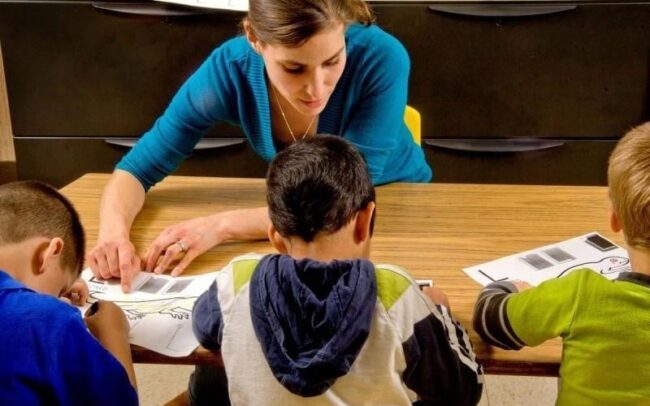
The practicum programs serve a dual purpose. On the one hand, they expose students to the educational environment in which they will later be called upon to work and provide educational services, and, on the other hand, to give them the opportunity to teach children with or without special needs, applying what they have learned in their Teaching Methodologies courses. More specifically, the practicums take place in educational settings such as kindergartens, general education elementary schools, and special education schools (S.M.E.A.).
PRACTICUM 1 AND 2 IN GENERAL EDUCATION
1. PRACTICAL TRAINING FOR THE PRESCHOOL TEACHING TRACK
PRACTICAL TRAINING IN GENERAL EDUCATION FOR PRESCHOOL TEACHERS 1 In the first level of Practical Training (winter semester), the primary objective is for students to become familiar with the preschool environment, interact with the children, and gain experience with teaching activities, so that by the following semester they will be prepared to take on teaching responsibilities. At this level, students complete 7 classroom observations in preschools and 3–5 courses at the university (depending on the scope of the semester). During each observation, the student completes observation guides, which focus on a specific aspect of the pedagogical process each time. Specifically, the observation guides cover:
- The preschool environment
- Spontaneous and organized activities in the preschool
- The full-day preschool and how it operates
- Teaching methods
- Educational tools: Play and books
- Educational tools: Habit, Work, Instruction, Example, Supervision, Discipline
- The goals and objectives of organized activities
- The principles of preschool education
- The needs of preschoolers—Activity content
The content of the observation guides is explained and discussed with the course instructor. In addition, the instructor gives a presentation each time regarding the subject of the observation. After the observations, feedback is provided on two levels: first, immediately following the observation with the visiting preschool teacher who accompanies the students during the observations; and second, collectively with the course instructor. During these meetings, the students discuss what they observed, their questions, their uncertainties, and their impressions. At the end of the semester, the students submit a portfolio containing the observation guides and a paper.
PRACTICAL TRAINING IN GENERAL EDUCATION FOR PRESCHOOL TEACHERS 2 In the second level of the Practical Training, students take on teaching responsibilities. Each student conducts 15 teaching sessions. The first five sessions are conducted in pairs over five different weeks, and the remaining 10 are conducted individually over two consecutive weeks. The student prepares the teaching plan in collaboration with the preschool teacher mentors who work with the department. This program is reviewed by the course instructor prior to its implementation. Between teaching sessions, feedback meetings are held with the course instructor and the mentors. During these meetings, students’ experiences, challenges, and questions are discussed, and depending on any gaps identified, lectures will be scheduled either by the course instructor or by other faculty members in the department. During these sessions, students—now armed with classroom experience—will be able to ask questions related to practical applications, the answers to which will assist them in their future teaching. At the end of the semester, students submit a complete portfolio of their teaching sessions. Their goal is to bridge the gap between theory and practice, which is achieved, first, through the students’ familiarization with and exposure to the educational setting, and second, through their engagement in teaching activities.
*Attendance at the Practicum is mandatory.
**Students are evaluated and graded based on the assessment of teaching observation checklists and research papers.
2. TEACHER TRAINING PRACTICUM
Instructor: Anastasia Raikou
TEACHER TRAINING PRACTICUM IN GENERAL EDUCATION 1 The General Education Practicum I aims to familiarize students with the classroom environment and the educational process through (a) observing lessons in all elementary school grades taught by experienced teachers and (b) a systematic feedback process that includes the analysis and interpretation of the phases of instruction and reflection on the educational, teaching practice.
As part of the General Education Teaching Practicum I, during the fifth semester of study, students make six visits to designated elementary schools in the municipalities of Volos and Agria, which include:
- Systematic observation of lessons in all subjects and all grades of the elementary school
- Completion of observation checklists in which, among other things, the phases, actions, and teaching methods, the methods and learning materials used in each subject and in each grade
- Discussion of the observations and teaching sessions led by the instructor and the teaching staff supporting the course
- Preparation of a research study
The teaching process is supplemented with feedback and in-depth analysis provided by the course instructor.
Attendance at students’ practicums in elementary schools is mandatory.
Students are evaluated and graded based on the assessment of teaching observation checklists and research papers.
GENERAL EDUCATION TEACHING PRACTICUM 2 The General Education Teaching Practicum II takes place during the sixth semester of study and aims to bring students who have chosen the teacher education track with actual teaching practice, not only in terms of developing and analyzing teaching models and approaches but also in terms of their implementation. For this reason, the course includes experimental teaching sessions conducted by the students, with the aim of familiarizing them with real-world situations in the school environment. Practical Exercises II take place at designated elementary schools in the municipalities of Volos and Agria and include:
- Trial teaching sessions one day each week and
- One full week of independent teaching
- Discussion of classroom observations and trial lessons led by the instructor and the teaching staff supporting the course
- Feedback from the course instructor
- Preparation of a study plan for teaching the interdisciplinary module.
Specifically, Teaching Practicum II unfolds in two phases:
- The first phase consists of 5 full-day teaching sessions in regular elementary school classrooms across all subjects taught by elementary school teachers. In order to assess the students’ ability and readiness to teach, after receiving the lesson material from the classroom teacher they are to substitute for, they then prepare a Lesson Plan for each subject they will teach. After the full day of teaching concludes, feedback on the students’ teaching follows, coordinated by the instructors during a meeting with the students.
- In the second phase of the practicum, students teach for one week in a elementary school classroom, utilizing all modern teaching and learning approaches. At the same time, they prepare an assignment in the form of a comprehensive Lesson Plan, which documents the theoretical and research-based rationale for their teaching and learning choices. The lesson plans and the assignment prepared by the students are evaluated.